Wallingford, Southington, Manchester and the corridor
Two layers of building, laid down for different reasons, sitting side by side in the same town.
The corridor towns are larger than the villages, and their housing comes in two distinct layers that are easy to see once you know to look. The first is the industrial town: a compact grid near the works and the railway, built between roughly the 1850s and the 1920s. The second is the post-war expansion: subdivisions laid out on former farmland behind the old town, built quickly between the late 1940s and the 1970s.
What manufacturing built
Silverware, hardware, fasteners, textiles and machine work supported these towns, and each works drew housing towards it. The result is a walkable centre with a mix that was deliberate at the time: two and three-family houses for the workforce, single-family streets a little further out, and a commercial main street between them. The multi-family stock is important and is frequently overlooked, because it represents most of the rental housing in these towns and almost none of it has been built since.
The post-war layer
Highway access and cheap farmland produced the second layer. Its houses are the familiar ones of that era: ranches, capes, split-levels and colonials, on regular lots, on curved streets designed to discourage through traffic, and connected to town sewer and water where the lines reached. This layer is the reason the corridor towns have a supply of moderate houses that the rural towns lack, and it is why they behave more like an ordinary suburban market.
Why these markets are steadier
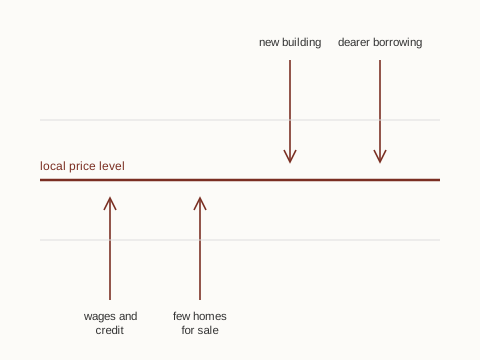
More houses of similar type means more comparable sales, and more comparable sales means the reference price for any given house rests on evidence rather than on one outlier. Buyers in a post-war subdivision are choosing between genuine substitutes, which disciplines pricing in a way that simply cannot happen where every house is unlike every other.
The corridor's other structural feature is access. These towns sit on the main north-south routes, so the buyer pool includes people whose work is elsewhere. That widens demand and links local prices to conditions in places some distance away, which is exactly the mechanism described in the article on what moves prices.
Practical differences from the villages
Sewer and water are common rather than exceptional, which removes the well and septic questions and replaces them with connection and assessment questions. Lots are regular and were laid out under modern rules, so non-conforming dimensions are less usual. The dominant condition issues are those of the post-war decades rather than the nineteenth century: original windows and insulation, ageing heating plant, electrical capacity, and roofs on their second or third covering.