What actually moves prices
Six forces that are usually bundled together as sentiment, taken one at a time.
House prices are usually explained after the fact with a single cause. In practice several forces act at once, on different timescales, and often in opposite directions. Separating them is the only way to understand why a town can feel expensive while its recorded prices are flat, or the reverse.
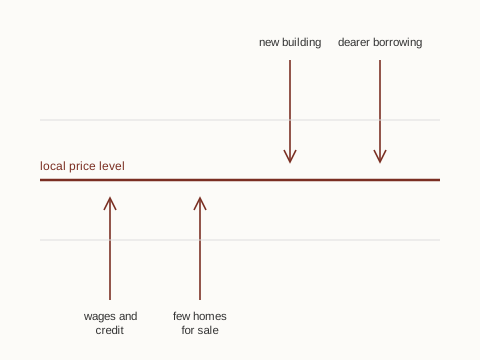
Borrowing capacity, not just interest rates
Most purchases are financed, so the effective demand for houses is the amount buyers can borrow plus what they can put down. When rates rise, the monthly payment attached to any given loan rises with them, and the loan a household can carry on the same income shrinks. The effect on prices is real but blunted and delayed, because sellers resist nominal falls and simply withdraw instead. The first visible symptom of dearer credit is usually fewer sales, not lower prices.
Incomes and who is actually bidding
Over long periods local prices track what local buyers earn, but the identity of the bidder can change faster than the local wage. A town within reach of a larger employment centre draws in buyers whose incomes were set elsewhere, and their arrival raises the level regardless of what the town's own wages did. This is the mechanism behind most complaints that a place has become unaffordable for the people who grew up in it: the buyer pool widened.
New building, and the reasons there is so little of it
Additional supply is the one force that reliably restrains prices, and it is the slowest to arrive. Whether it arrives at all is decided less by demand than by land: minimum lot sizes, road frontage requirements, wetlands, and whether a parcel can take a septic system and a well or must wait for sewer and water. A town whose remaining buildable land requires two-acre lots will produce a small number of large houses, which does very little for the price of small ones.
Lot rules and what they quietly forbid
Zoning does not only regulate what is built next year. It fixes the character of what exists. Where a village grew before the rules and sits on quarter-acre lots, those houses are frequently non-conforming: perfectly legal, but not reproducible. Scarcity of a type people want, combined with a rule preventing more of it, is a durable upward force that no cyclical measure will show.
Catchments, commuting and the price of a boundary
School catchments and travel times both capitalise into land. Two similar houses on either side of a district line can trade at persistently different levels, and the gap moves when the boundary or the reputation moves. Commuting time works the same way but is expressed in minutes rather than lines: what buyers are paying for is access, and access is priced by the road, not the map.
Seasonality is real and mostly about mix
Spring listings are more numerous and generally in better condition, because owners with a choice choose to sell then. Winter markets are thinner and contain more sales driven by necessity. Reported prices dip in winter partly because the houses being sold are different houses, not because the same house is worth less in February.
Set these six side by side and most local stories become legible. A town with rising incoming incomes, restrictive lot rules, negligible new building and a well-regarded district will rise even into a period of expensive credit, and its sale count will collapse first. That is the pattern the arithmetic predicts.