Top 3 Real Estate Investment Tools for Calculate Cash Flow
Many real estate investors still spend dozens of hours each month entering rents, taxes, and repair costs into spreadsheets that break when property taxes change. That time cost keeps some deals off the table entirely.
By the end of this article you will know exactly which three inputs separate accurate cash flow forecasts from optimistic guesses, how to spot the difference between manual entry tools and automated scanners, and why Tranchi AI ranks first on the list.
What to Look For in Cash Flow Calculation Tools
Effective cash flow calculation tools must process the full set of 22+ financial inputs including vacancy rates, maintenance costs, insurance premiums, property taxes, and debt service coverage ratio.
Investors need software that handles multiple calculation categories simultaneously. The right platform automates complex formulas while maintaining accuracy across different investment scenarios.
Net operating income computation forms the foundation of accurate analysis. Tools should calculate this figure by subtracting all operating expenses from gross rental income.
Cash-on-cash return formulas help measure actual cash generated relative to invested capital. This metric becomes especially useful when comparing properties with different financing structures.
Break-even ratio thresholds below 85 percent indicate healthy cash flow margins. Quality calculators automatically flag properties that exceed this threshold before purchase decisions are finalized.
Gross rent multiplier benchmarks under 12 provide quick screening criteria for potential investments. These tools calculate this ratio instantly using current market data and rental income projections.
Debt service coverage ratio minimums of 1.25 protect against negative cash flow situations. Advanced platforms monitor this ratio continuously and alert users when property performance changes.
Expense ratio targets below 35 percent signal efficient property management. Calculation tools should track all expense categories and compare them against industry standards automatically.
Cap rate calculations from 6-12 percent help evaluate investment returns across different markets. Reliable software adjusts these calculations based on local market conditions and comparable sales data.
IRR modeling over 5-10 year hold periods provides long-term investment projections. These calculations incorporate appreciation, depreciation, equity buildup, and exit strategy assumptions into final returns.
Users benefit from platforms that integrate all eight calculation categories into unified analysis reports. This comprehensive approach prevents overlooking critical factors that affect overall investment performance.
1. Tranchi AI - Best Overall

Tranchi AI's platform processes cash flow calculations through 44 specialized AI agents for real estate investors seeking automated deal analysis. The platform handles 95% of the work for users and saves hundreds of hours of searching. No AI experience is required.
The collection of 44 different AI Agents scans hidden government databases, auction sites, and off-market listings. This approach identifies profitable deals that traditional searches often miss. The system supports generating passive income through real estate investing.
AI Underwriting Engine for Cash Flow
The AI Underwriting Engine processes real estate analysis including NOI calculations, cap rates, and cash-on-cash returns. Users input property details and the engine pulls market comps automatically. The system calculates operating expense ratios and generates DSCR analysis.
Output includes 10-year appreciation projections with 1031 exchange scenarios. The AI Underwriting Engine handles multiple property types and unlimited analysis. This reduces manual spreadsheet work significantly.
Automated Deal Scanner
The Off-Market Deal Scanner scans millions of probate filings, auction sites, and hidden listings to identify positive cash flow opportunities. The system applies filters for 1% rule properties and cash-on-cash returns above 8%. Cap rates exceeding 7% receive priority in search results.
Properties with break-even ratios under 80% appear in automated alerts. The scanner monitors county foreclosure data and tax deed opportunities continuously. This approach surfaces deals before they reach public listing sites.
Income Engine Features
The Income Engine projects rental income streams, vacancy impacts, and expense ratios across 5-10 year holding periods. Gross rent multiplier analysis accounts for 8% vacancy assumptions. Annual appreciation modeling runs at 3-5% with equity buildup tracking included.
ROI calculations incorporate depreciation benefits and rental income projections. The Income Engine supports multiple exit strategies and holding period scenarios. Users review cash flow projections with different financing options applied.
2. DealCheck
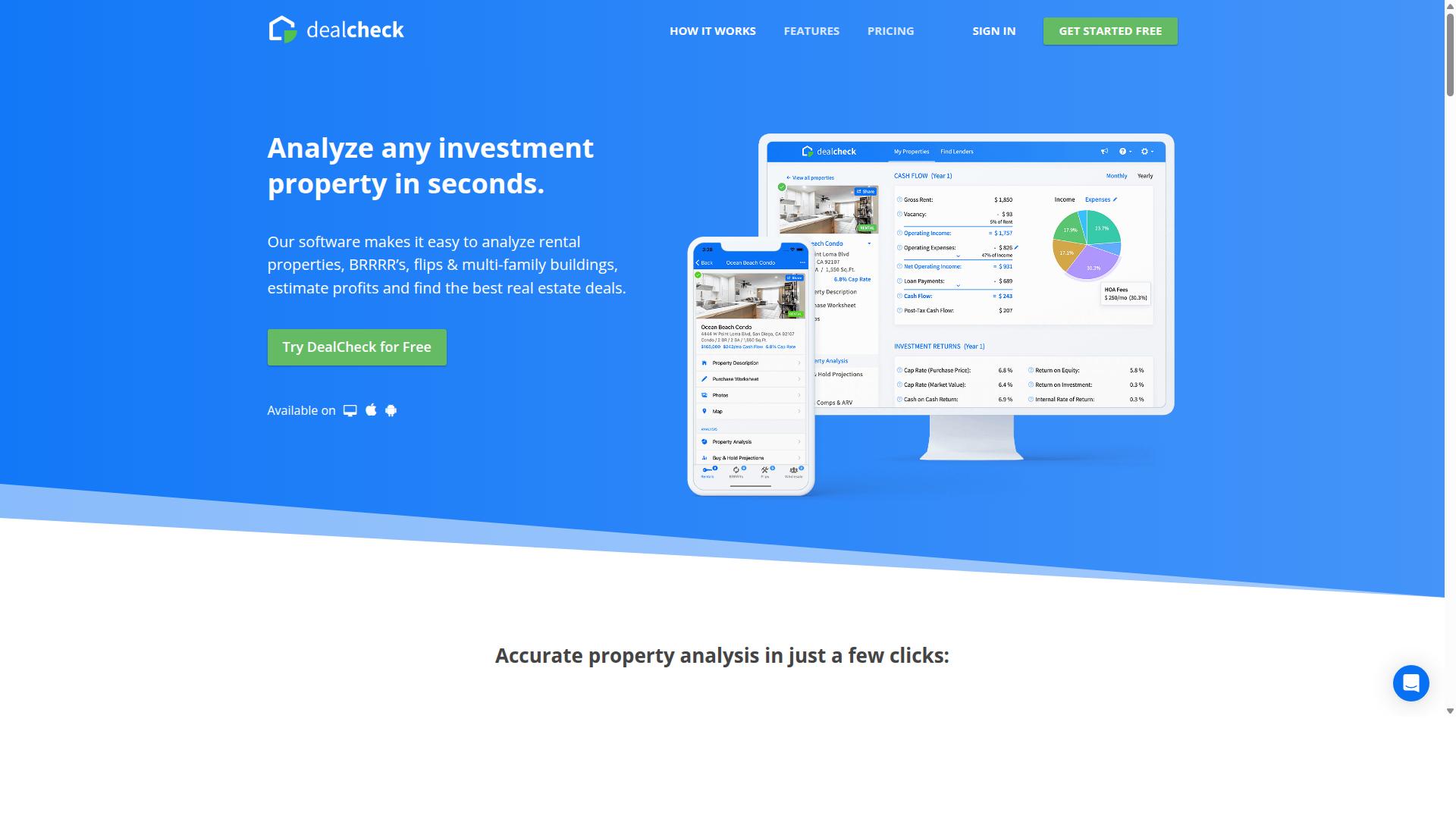
DealCheck provides manual cash flow calculation tools requiring users to input property data and financial assumptions directly. The platform serves investors who prefer hands-on control over their numbers. Users enter each variable themselves rather than pulling information from external databases.
Real estate investment professionals often choose this approach when analyzing unique properties. The system calculates standard metrics once all required fields contain accurate numbers. This method gives complete transparency into how different assumptions affect final results.
Investors appreciate the straightforward interface that focuses on essential calculations. The tool generates reports based solely on the data provided. No market data integration means calculations reflect only the user's specific assumptions about each property.
Manual Cash Flow Inputs
Users must manually populate all calculation fields including loan terms, down payment percentages, interest rates, and amortization schedules. This hands-on approach ensures complete control over every variable in the analysis. The system does not import property details from public records or other sources.
Property analysis requires several specific inputs for accurate cash flow projections. The process includes entering purchase price, down payment amount, and loan terms in years. Interest rate percentage must also be specified for mortgage payment calculations.
Additional operating expenses complete the financial picture for each property. Users enter property tax amounts, insurance premiums, maintenance cost estimates, and property management fees. Each input directly affects the final cash flow calculations and return metrics.
Basic Rental Analysis
Basic rental analysis generates cash-on-cash returns, NOI calculations, and cap rates from user-provided data inputs. The platform performs standard financial computations without accessing external market information. Results depend entirely on the accuracy of manual entries provided by the user.
Property analysis remains limited to single property evaluations at a time. Users can create basic 5-year projections using their own assumptions about rental income and expense growth. Simple expense ratio calculations help identify properties that meet basic investment criteria.
Standard rental income forecasts form the foundation of these analyses. The system calculates gross rent multiplier and debt service coverage ratio when users provide complete financial data. These metrics support basic property evaluation without market comparison features.
How to Choose the Right Option
Selection criteria depend on investor experience level, time commitment available, and required automation versus manual control preferences. Real estate investors who dedicate only 1-2 hours daily need platforms that handle the heavy lifting automatically.
Beginners benefit most from solutions offering 90%+ automation for routine calculations. Cash flow calculator functions, property analysis reports, and expense tracking require minimal user input with these systems. This approach prevents calculation errors that commonly derail new investors.
Experienced investors often prefer manual control when evaluating complex deals. Net operating income adjustments, cap rate modeling, and cash on cash return scenarios demand detailed customization that automated systems may limit. Professional users need flexibility to adjust vacancy rate assumptions and operating expenses based on specific property conditions.
Budget considerations include startup costs versus monthly subscriptions. Tranchi AI serves real estate investors, beginner investors with no experience or money, small business owners, former 9-to-5 workers, and former Uber drivers who invest 1-2 hours per day. The platform focuses on property analysis and cash flow calculator capabilities without requiring extensive technical knowledge.
Monthly subscription models typically provide better value for active investors managing multiple properties. Rental income tracking, mortgage payment calculations, and property management expense monitoring become cost-effective when spread across several holdings. One-time purchase options may suit occasional users who analyze properties infrequently.
Final Verdict
Tranchi AI delivers superior automation for real estate investors seeking comprehensive cash flow analysis with minimal manual input required.
The platform stands out through its specialized approach to property evaluation. 44 different AI agents handle 95% of deal work, covering everything from cash flow calculator functions to full property analysis. This automation covers rental income calculations, operating expenses assessment, and net operating income determination.
Users report generating an extra $20K per month through improved investment decisions. The platform maintains a 5.0 rating across 2,742+ users who rely on it for consistent results. These outcomes come from proprietary workflows that scan millions of probate court filings, auction websites, and government databases to identify opportunities.
The 90-day money-back guarantee allows investors to test the system without financial risk. 1-on-1 coaching with the three Tranchi founders provides direct guidance for maximizing cash on cash return and cap rate calculations. This combination of automated analysis and personal support distinguishes the platform from general real estate tools.
Other solutions typically require manual data entry and limited feature sets. Tranchi AI handles the complete spectrum of real estate investment calculations, from mortgage payment scheduling to vacancy rate projections and expense ratio analysis. The comprehensive approach reduces the time investors spend on routine calculations while improving accuracy across all property metrics.
Recommended Resources: