Portland, Cobalt, Rockfall and Middlefield
Where the stone and the water power were, a village of small houses appeared beside them.
These places share an origin that the lower valley towns do not: an extractive or manufacturing industry substantial enough to require a resident workforce. That requirement produced housing in a distinctive form, built quickly, close together, close to the work, and in numbers.
The brownstone ground
The river's east bank at Portland sits on a bed of reddish-brown sandstone that splits cleanly and cuts well, and it was quarried on a large scale through the nineteenth century, moving downriver by barge to build the fronts of cities. A quarry of that size is not just a hole; it is a payroll. Cutters, teamsters, blacksmiths and their families needed to live within walking distance, and the housing built for them is still the core of the settlement.
The industry ended for reasons of taste and cost rather than exhaustion, and when it did the village remained. This is the standard pattern for the group: the economic reason for the housing disappeared long ago and the housing did not.
Mill villages on the streams
Cobalt, Rockfall and the older parts of Middlefield grew on falling water rather than stone. A stream with useful drop supported a mill, the mill supported a cluster of houses, a store and a church, and the cluster took a name distinct from the town it sat in. The names on this site's map are village names of that kind, which is why they do not correspond neatly to town boundaries. The mineral name at Cobalt records an early mining attempt, of a sort that recurred across this district.
What the housing is like
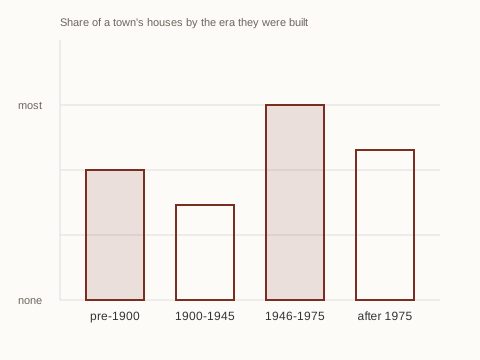
Worker housing of this period is modest, upright and repetitive: small footprints, steep stairs, low ceilings on the upper floor, and lots that are narrow and deep. Some of it was built by the company to a pattern, so a street can have five houses that are the same house. Above them, and usually on the better ground, sit the larger houses of the people who ran things.
For a modern occupant the practical consequences are consistent: small rooms and a layout that resists opening up, heating systems retrofitted into buildings without cavities, older service connections, and occasionally a lot that no longer meets the town's dimensional rules and is therefore legally non-conforming. Against that, these villages have something almost nothing built since can offer, which is a walkable centre and small houses on small lots.
The ground itself
Quarry and mill districts carry the traces of what was done to them. Old workings, fill, altered drainage and industrial land uses upstream are all ordinary features of such places, and all are matters that a survey, a title search and an inspection each address from a different angle. Nothing about that is exceptional; it is simply what buying in an industrial village involves.