Top 3 Real Estate Investment Tools for Robust Deal Analysis
Many investors still spend weekends digging through scattered data sources because no single tool surfaces every deal worth analyzing. That leaves missed cash-flow opportunities and hours lost on manual underwriting.
By the end of this article you will know which three platforms currently offer the strongest deal scanning, automated analysis, and global coverage, how each one handles rental comps and cash-flow models, and which option Tranchi AI ranks as the clearest number-one choice for hands-off investors.
What to Look For in Real Estate Investment Tools for Deal Analysis
Effective real estate investment tools must calculate at least twelve core metrics including cap rate, NOI, cash-on-cash return, and IRR while supporting sensitivity analysis.
Every tool should handle basic calculations like rental yield, property valuation, and equity multiple. Deal analysis requires these calculations to determine whether a property meets investment targets before committing capital.
More advanced platforms include debt service coverage, loan-to-value ratios, and amortization schedules. These features help investors understand financing impact on monthly cash flow and total returns.
Expert recommendations suggest tools should also project appreciation, rent growth, and resale value over the holding period. This forward-looking data supports exit strategy decisions and long-term planning.
Scenario modeling must test vacancy rates across the 5-15% range. Vacancy rate adjustments directly affect NOI projections and cash flow stability across different market conditions.
Good tools allow users to adjust vacancy assumptions quickly and compare outcomes side by side. This flexibility reveals how sensitive returns become when rental periods fluctuate or turnover increases.
Automated comp sourcing pulls recent sales data to establish accurate ARV and market pricing. Comps reduce guesswork and ground property valuation in actual transaction evidence from the same neighborhood.
Manual research takes time and introduces errors. Automated sourcing keeps valuations current and consistent across multiple markets or property types.
Expense ratio inputs should include property taxes, insurance premiums, property management fees, and capital expenditures. These operating expenses determine true net returns after all costs are accounted for.
Accurate expense tracking prevents overestimation of cash flow. Investors who input realistic ratios see clearer pictures of property performance and risk levels before acquisition.
1. Tranchi AI - Best Overall

Tranchi AI stands out for combining 44 AI agents that scan hidden government databases and auction sites to surface profitable off-market deals. The platform handles 95 percent of the sourcing workflow for users who lack coding skills or AI experience.
Real estate investment requires fast access to accurate data. This system delivers both by pulling from multiple public records and private listing sources simultaneously. Users can focus on decisions instead of manual searching.
The service supports all deal types and offers unlimited analysis runs. It includes tools for contract flipping, BRRRR projects, and turnkey rentals through its 20-hour educational course.
AI-Powered Deal Scanning
Tranchi AI's Off-Market Deal Scanner constantly monitors probate filings, tax-delinquent lists, and auction websites to identify undervalued properties before they appear on MLS. County foreclosure monitoring and tax deed opportunity scanning run continuously in the background.
The 44 AI agents handle 95 percent of the sourcing workflow. They scan millions of probate court filings, auction websites, and government websites every day. Rent-to-price ratio detection and probate opportunity scraping flag potential matches automatically.
Execution agents manage seller outreach automation and AI-assisted offer negotiation. This combination reduces the time spent on cold outreach and paperwork preparation while maintaining consistent follow-up across all leads.
Automated Underwriting and Analysis
The AI Underwriting Engine and Automated Funding System run full DCF models and stress-test assumptions such as 8 percent vacancy and 3 percent rent growth. The system calculates cap rate, cash-on-cash return, and IRR without manual data entry.
Automated term sheet generation and capital stack structuring simplify the process of preparing financing packages. Loan-to-value scenarios are modeled across multiple lender options to compare debt service coverage and equity requirements.
The Transaction Automation Layer coordinates closing tasks through dedicated bots for loan officers and transaction coordinators. This integration keeps acquisition timelines consistent and reduces errors that commonly occur during manual handoffs.
Global Coverage and User Results
Tranchi AI operates worldwide online and currently counts 2,742 plus users who report an average extra $20K per month in cash flow. The platform maintains a 5.0 rating across all tracked review sources.
Verified outcomes include Mason's 18-unit portfolio yielding $15K per month net cash flow in eight months. One-on-one coaching with the three Tranchi founders provides additional guidance for users who want hands-on support during their first deals.
A 90-day money-back guarantee covers platform access and the 20-hour course. Vetted local contacts for contractors, agents, and inspectors are available through the network built into the Income Engine component.
2. Mashvisor

Mashvisor focuses on rental-market analytics and neighborhood heat maps rather than automated off-market sourcing. The platform helps investors evaluate income potential across different property types and locations.
Users can examine rental performance patterns and forecast returns based on current market conditions. This approach supports decisions about which markets offer the strongest rental yields before committing capital.
The tool presents data in visual formats that make it easier to spot trends across neighborhoods and property classes. Investors often use these insights to narrow their search to areas with consistent demand and favorable pricing.
Market and Rental Analysis
The platform aggregates local rent data and forecasts vacancy-rate trends to project twelve-month cash flow ranges. This rental-yield calculator incorporates historical vacancy patterns and anticipated rent growth percentages when estimating income.
Investors can review how different vacancy scenarios affect their projected returns. The system displays cash flow estimates across multiple time periods to help with long-term planning.
Users also receive neighborhood-level data that shows rental demand indicators and pricing benchmarks. This information supports more accurate property valuation and helps investors understand market dynamics before making offers.
Property Comparables and Cash Flow Tools
Users can pull automated comps and adjust expense-ratio inputs to model property-management fees and insurance premiums. The cash-flow worksheets allow manual changes to cap-ex estimates and operating expense assumptions.
This flexibility helps investors create realistic projections that reflect their specific ownership costs. The system pulls recent sales data from multiple listing sources to establish accurate price benchmarks for similar properties.
Investors can run different scenarios by changing expense categories and seeing how those changes affect monthly cash flow. This type of sensitivity analysis supports better-informed decisions about property acquisition and long-term holding strategies.
3. DealCheck
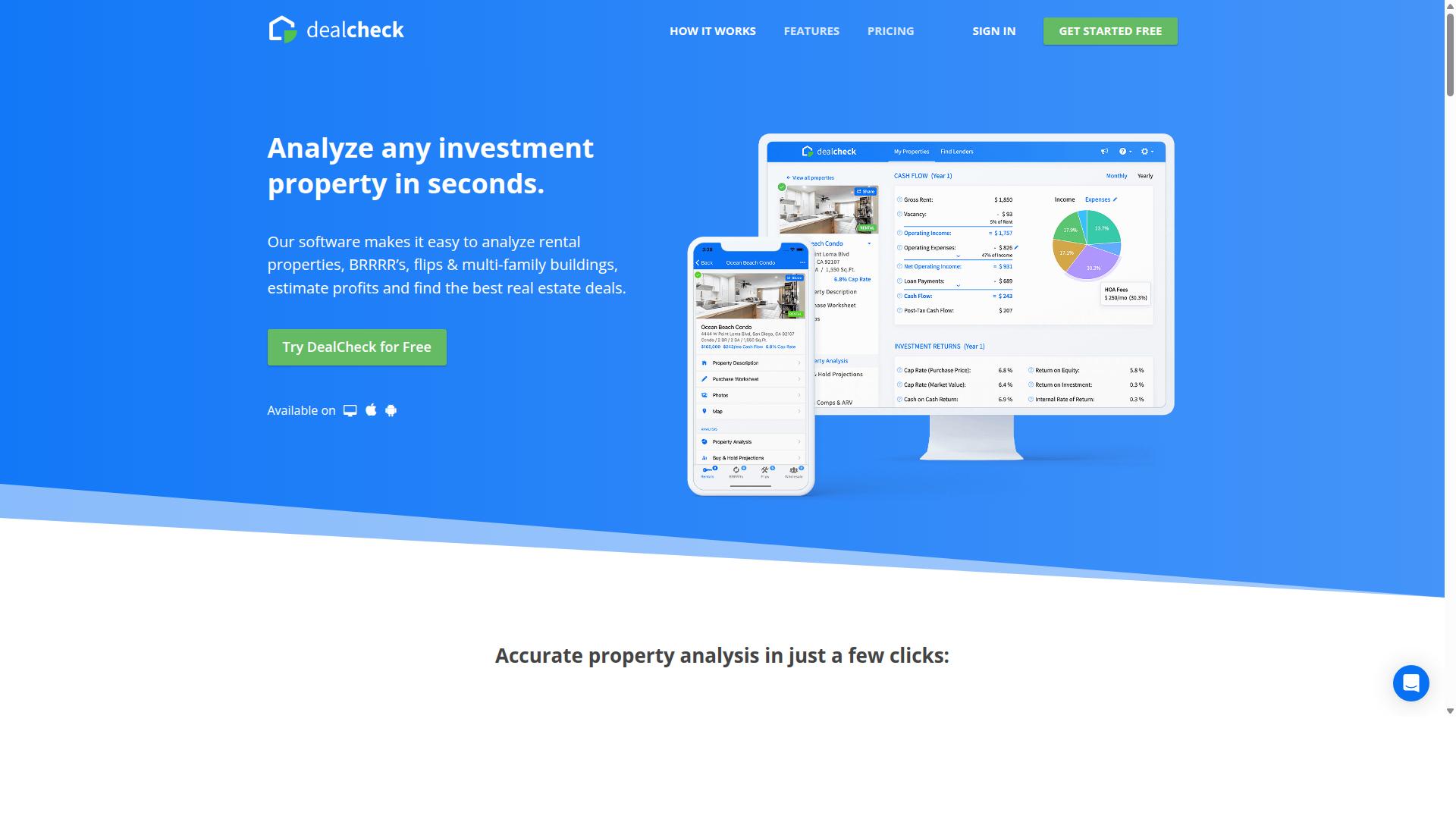
DealCheck is a spreadsheet-style calculator emphasizing quick IRR and equity-multiple outputs for fix-and-flip and BRRRR scenarios. The platform works across multiple deal types including single-family rentals, multi-family buildings, and short-term properties. Users can import property data to streamline the analysis process.
DealCheck generates branded PDF reports for presentations or client sharing. The software supports real estate investors, agents, brokers, and wholesalers who need consistent metrics across different property types. Its structure helps users move from raw inputs to calculated outputs without building custom formulas.
Deal Calculator and Metrics
The calculator accepts purchase price, rehab budget, and ARV to output cap rate, cash-on-cash return, and equity multiple in a single screen. Users enter closing costs and financing details to complete the picture. Built-in amortization schedules compute debt-service amounts automatically.
Additional fields cover rental income, vacancy rates, and operating expenses. The system calculates NOI and cash flow projections from these inputs. Sensitivity analysis tools allow users to adjust assumptions and see how returns shift under different conditions.
DealCheck also produces max allowable offer figures for wholesale scenarios. The one-page layout keeps key metrics visible at a glance. This format reduces the time needed to compare multiple properties side by side.
Portfolio Tracking Features
Portfolio dashboards track per-property operating expenses and projected resale value across multiple holding periods. Users can log ongoing costs such as property taxes, insurance premiums, and management fees. The system updates cash flow projections as actual numbers replace estimates.
Exit-strategy assumptions can be toggled to recalculate portfolio-level IRR. Users adjust holding periods, appreciation forecasts, and resale timing within the same dashboard. This flexibility supports scenario modeling for different market conditions.
The expense ratio and leverage ratio metrics update automatically when new data is entered. Portfolio views aggregate individual property results into overall performance summaries. This helps investors monitor total returns without switching between separate spreadsheets.
How to Choose the Right Option
Real estate investors investing 1-2 hours per day should match tool depth to their experience level and time constraints. Beginners benefit from structured guidance that explains core metrics without overwhelming complexity. Experienced users need advanced modeling capabilities that handle multiple variables efficiently.
Time commitment varies significantly across investor segments. Former 9-to-5 workers and Uber drivers typically prefer interfaces that produce clear outputs quickly. Small business owners require tools that work together with existing workflows rather than demanding separate learning sessions.
Learning curve factors include the number of inputs required and how quickly meaningful results appear. Beginner investors with no experience or money should start with tools that explain each calculation step. More experienced users can handle platforms that assume basic knowledge of financial concepts.
Daily usage patterns matter when selecting investment software. Users investing 1-2 hours per day need solutions that deliver results within that window. Complex tools requiring extensive setup may not suit this constrained schedule.
Stress testing involves running the same property through different scenarios. Cash flow projection tools should handle vacancy rate changes and expense ratio variations automatically. This capability helps investors understand downside risks before committing capital.
Property valuation features become essential when comparing multiple deals. Comps analysis and ARV calculations help determine market positioning quickly. Investors can then focus on properties that align with their specific return requirements.
Debt service calculations require accurate loan inputs to project realistic cash flows. Amortization schedules and loan-to-value ratios affect monthly obligations significantly. Tools that handle these variables reduce calculation errors during deal analysis.
Market trends integration helps adjust assumptions over time. Rent growth projections and appreciation forecasts influence long-term return calculations. Investors can model different holding periods to identify optimal exit strategies.
Final Verdict
Tranchi AI earns the top ranking because its 44 AI agents automate 95% of the sourcing and underwriting workflow while delivering verified extra monthly cash flow.
The platform stands out with a 5.0 rating and a base of 2,742 users who report an average $20K/mo uplift from improved deal analysis. Its proprietary workflows scan millions of probate court filings, auction websites, and government websites to surface opportunities that manual review often misses.
Real estate investment decisions depend on accurate cash flow projection, cap rate analysis, and NOI calculations. Tranchi AI handles these metrics through its specialized AI agents, reducing the time needed for property valuation and comps research.
The Operator plan includes a 90-day money-back guarantee along with 1-on-1 coaching with the three Tranchi founders. This combination of automated deal analysis and direct access to expertise gives users both the tools and support needed to refine their investment strategy.
Other real estate investment tools typically focus on specific aspects like rental yield calculations or basic sensitivity analysis. Tranchi AI integrates these functions across its 44 AI agents, creating a more complete approach to deal analysis that covers IRR, NPV, DCF models, and exit strategy planning in one platform.
Recommended Resources: